
My new friend and professional library colleague, Sara Gonzales, has a new book out today on 3D printers in libraries (see below), so it seemed like a good time to list some of the best books, papers, and resources on the topic.
Books
Here is a selection of the best up-to-date books to learn about deploying 3D printers in your library.
3-D Printers for Libraries by Jason Griffey
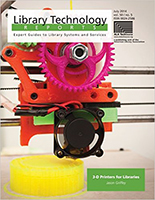 This title is actually an issue of Library Technology Reports from ALA Tech Source. The report covers how 3D printers work, common terminology, types of plastic, prices and specifications for printers, and staff skill requirements. Published in 2014.
Buy from the ALA Store, Amazon, or Barnes & Noble.
3D Printing: A Powerful New Curriculum Tool for Your School Library by Lesley M. Cano
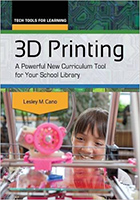 Part of the “Tech Tools for Learning” series. This book is aimed at the K-12 school librarian. “Written in non-technical language, the book introduces the technology, shows how to get started, and offers ideas for creating project-based learning models.” Published in 2015.
View details and find a place to buy or borrow at Google Books.
3D Printing: A Practical Guide for Librarians by Sara Russell Gonzalez and Denise Beaubien Bennett
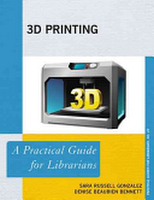 This title is the newest volume (#22) in the “Practical Guides for Librarians” series. The comprehensive book covers everything from writing the original proposal to selecting printers, addressing staffing issues, developing policies, and more. Published in 2016.
View details and find a place to buy or borrow at Google Books.
Papers
Progress in the Making: An Introduction to 3D Printing and Public Policy by American Library Association
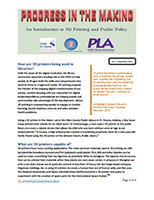 The first report from the American Library Association in the “Progress in the Making” series covering 3D printers and legal liability and concerns for library professionals. Published in September 2014.
Access the full-text paper (PDF).
Progress in the Making: 3D Printing Policy Considerations through the Library Lens by Charlie Wapner
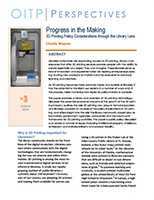 In this second report in the “Progress in the Making” series from the American Library Association, Wapner urges librarians to develop policies to “address the social, technological and political complexities that result from the rise of 3D printing.” Published in January 2015.
Access the full-text paper (PDF).
Resources
Here is a selection of helpful resources on 3D printers in libraries.
- 3D Printing Glossary – A LibGuide of 3D printing terms from Kent State University Libraries.
- How 3-D Printing Works – A good tutorial from HowStuffWorks.
- Librarian’s Guide to 3D Printing @ Your Library – A LibGuide from UF Libraries.
- Map of 3D Printers in Libraries – Amanda L. Goodman’s page with an interactive Google map with over 650 entries separated into categories.
- Thingiverse – A large community for finding, making, and sharing 3D models, by MakerBot.
- Tinkercad – A basic online CAD website to create 3D models for printing.
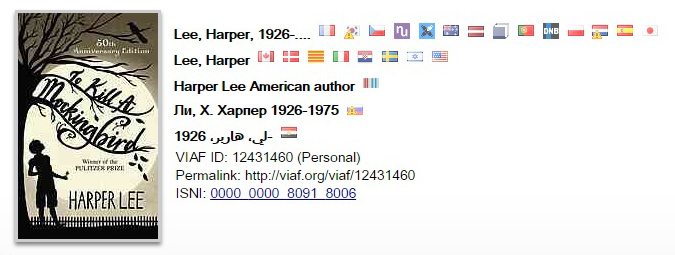
 The Virtual International Authority File (VIAF) is not a new service, but one that has become more prominent in recent times due to the direction of OCLC (starting in 2012) and the rise of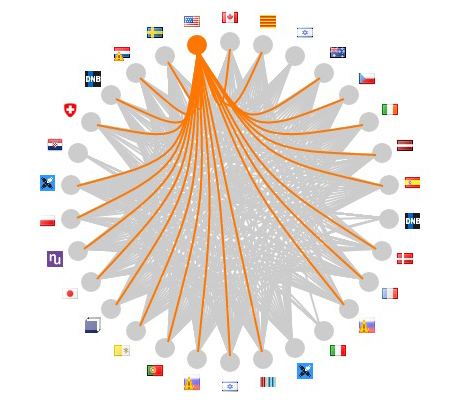
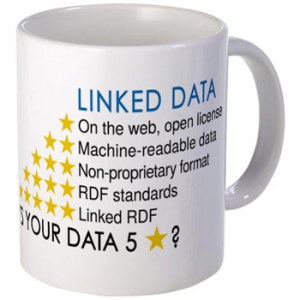
 “Jointly released by OCLC and the Library of Congress, this white paper compares and contrasts the compatible linked data initiatives at both institutions. It is an executive summary of a more detailed technical analysis that will be released later this year.” Published in 2015.
 Part of the “Synthesis Lectures on the Semantic Web: Theory and Technology” series. OCLC looks at Linked Data in cataloging and its products. Topics include authority records including VIAF, cataloging and FRBR, text mining, and the library Linked Data cloud. Published in 2015.
 This title is actually an issue of Library Technology Reports from ALA Tech Source. The report covers basic metadata in libraries and museums, Linked Open Data (LOD), case studies including BIBFRAME, and “issues, opportunities, and trends” in metadata. Published in 2013.
 In this book published by the American Library Association, the authors cover Linked Data and focus on the metadata standards supporting it. They present key concepts of metadata including metadata modelling, cleaning, reconciling, enriching, and publishing. Published in 2014.